How Regular Lubrication Helps Prevent Industrial Equipment Failure
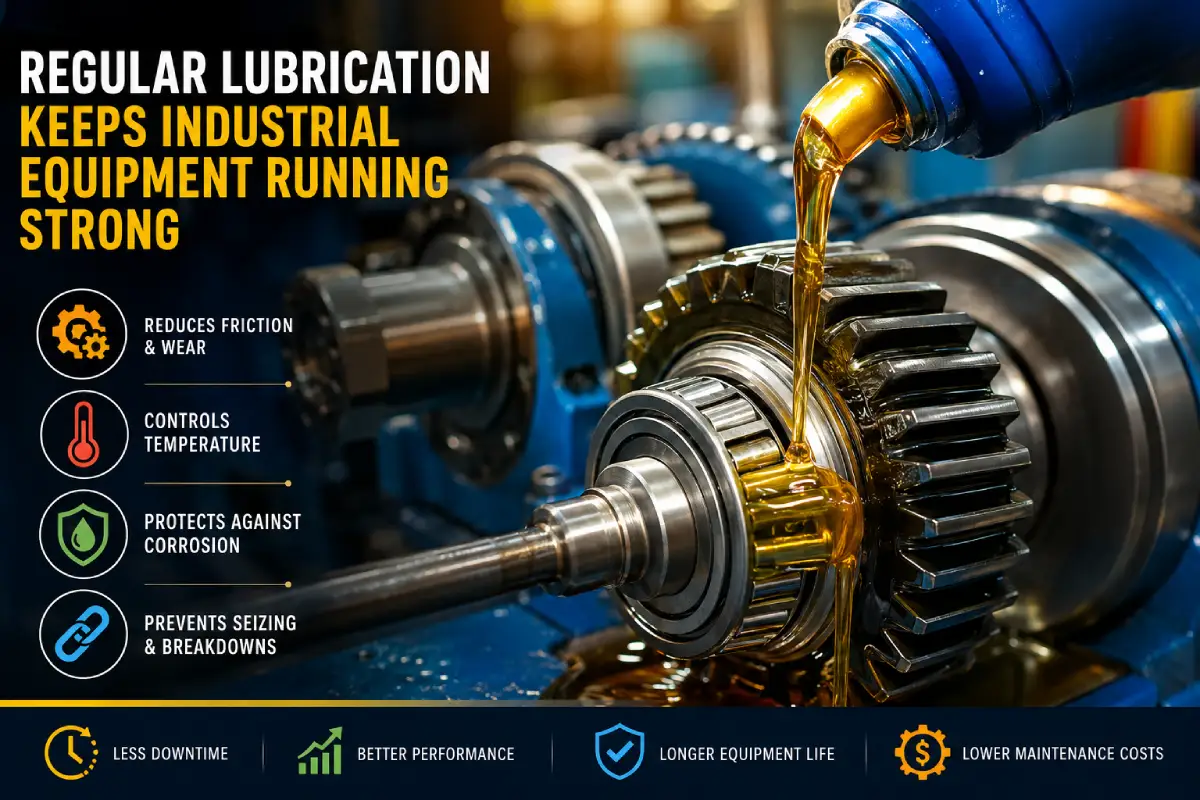
No organisation that depends on industrial machinery ever wants to see it grind unexpectedly to a halt. But of course, this can happen from time to time, with inadequate or irregular lubrication being a frequent contributory factor.
The use of appropriate lubrication solutions from RS as part of a well-structured planned maintenance programme can go a long way to keeping equipment operating reliably. This helps minimise costly periods of downtime.
With lubricants playing a fundamental role in reducing friction, wear, and the risk of premature breakdowns, these specialised oils and greases can be key to plants’ efforts to maintain dependable and efficient operations.
Table of Contents
What Role Does Lubrication Play in Machinery?
Most industrial equipment contains multiple components that move against, around, and through each other. Examples include bearings rotating, chains passing over sprockets, gears meshing together, and shafts turning within housings.
Two surfaces moving relative to one another in such machines can result in friction. Although some friction is inevitable and unavoidable, organisations that oversee the use of industrial machinery want to avoid excessive friction.
Elevated friction, after all, doesn’t “just” waste energy and generate heat. It can also accelerate surface wear, potentially bringing equipment gradually closer to the point of outright failure.
This brings us to the role of lubricants. These oils and greases, when added to machinery, form a protective film between moving metal surfaces. This helps minimise direct metal-to-metal contact between such components as bearings, gears, shafts, and seals. As a result, friction can drop and wear can be reduced.
Even better, the right lubrication solutions do not merely bring down friction; they can also help manage heat, protect against corrosion, and (in circulating oil systems) help carry contaminants and wear particles to filtration equipment.
4 Ways in Which Routine Lubrication Can Be Key to Preventing Equipment Breakdowns
A disciplined and regular lubrication schedule can have the following positive effects on machinery, thereby keeping it running trouble-free for longer:
-
It Drives Down Friction and Wear
The need to reduce friction is one of the primary reasons to invest time and care in routine lubrication.
In the absence of such lubrication, contacting surfaces can be subject to high levels of friction and mechanical wear over time. This can gradually damage components and alter their operating characteristics.
Maintaining a protective film between these surfaces can be especially important for components such as bearings, gears, chains, and other moving mechanisms that experience continuous or repeated movement.
-
It Helps Control Operating Temperatures
Friction produces heat. If excessive friction develops unchecked within machinery, an associated rise in operating temperatures can potentially speed up lubrication degradation and component wear.
These various factors, then, are very much interlinked. When the appropriate lubricant is used for a particular application, this can greatly help reduce friction and contribute to effective heat management.
Still, business decision-makers should bear in mind from a temperature-control perspective that greases, oils, and sprays should not all be treated as interchangeable. Whatever lubricant is chosen, it will need to retain suitable properties across the anticipated operating-temperature range, rather than simply being appropriate under normal ambient conditions.
-
It Guards Against Corrosion
Metal surfaces can eventually corrode when they come into direct contact with moisture and other chemically active substances.
Again, presuming a suitable lubricant is chosen for the given machinery and setting, it can help provide a protective layer to shield surfaces from environmental exposure.
Some products are even specifically formulated to provide corrosion protection. This can make them especially valuable for use in machines that operate in demanding environments, encompassing outdoor installations, washdown areas, and applications where equipment may be exposed to water or humidity.
-
It Can Reduce the Risk of Components Seizing
If equipment isn’t sufficiently and regularly lubricated, friction and wear can increase to the point where moving components become difficult to operate. In extreme cases, such parts might even seize.
By contrast, such equipment undergoing routine lubrication can help maintain the separation between moving surfaces. This, in turn, can significantly reduce the likelihood of seizure caused by inadequate lubrication.
This ought to be a particularly urgent priority, then, for equipment where seizure could lead to a major and long-lasting interruption to production.
Conclusion: Don’t Underestimate the Link Between Lubrication and Equipment Reliability
Ultimately, regular and correctly applied lubrication can be one of the most effective ways to reduce friction, wear, and lubrication-related equipment failures.
A well-designed lubrication programme can help address various causes of wear, thereby helping to make costly breakdowns a much rarer event.
In this way, regular and appropriate lubrication can be a central plank for ensuring smoother and more efficient operations for many years to come.